Shop Project - Documentation
Request Flow (Runtime Lifecycle)
How a request moves from the global HTTP entry point to the final HTML output through the project.
Goal
The flow is intentionally linear: entry, initialization, routing, access checks, dispatcher, and output. This keeps business logic separate from rendering.
Main Project Flow
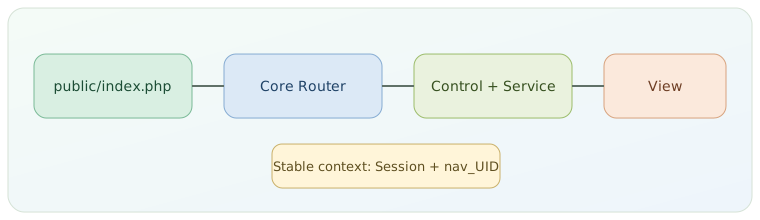
- public/index.php defines the security constant SECURE_INCLUDE and loads app/bootstrap.php.
- cApp::run() sequentially starts session, database connection, router, and access layer.
- cRouter::init() reads language, target page, and nav_UID from the URL and stores them stably in the session.
- cSecurity::check_user_access() validates ACL permissions for the requested route before any code execution.
- renderPage() loads the route mapping from app/control/map.php and executes the matching controller action.
- The rendering views read labels and context properties exclusively from cApp and cSession, never directly from superglobal URL parameters.
Simplified Order
- SECURE_INCLUDE definition $\rightarrow$ public/index.php loads app/bootstrap.php.
- cApp::run() initializes all global core components (Session, DB, Router, ACL).
- renderPage() handles the final control dispatch into the mapped content route.
Layer Visualization
Developer Guidelines (What to watch out for)
- Language and page contexts belong exclusively to the router domain, never inside view logic.
- Security and authorization checks must absolutely finish before any output generation begins.
- If a requested route does not exist in the mapping, the predefined fallback to the home node triggers.
- The dispatcher process serves orchestration purposes only and must not contain isolated business logic.